
Chronic pain affects millions of people worldwide, yet for many, the cause is not always structural damage but nerve irritation — an often-overlooked source of persistent discomfort. Traditional pain management approaches, from medications to surgeries, tend to focus on symptom control or correcting mechanical problems, leaving neuropathic components unresolved.
Enter Perineural Injection Therapy (PIT) — a minimally invasive, restorative technique designed to calm irritated peripheral nerves and initiate true healing at the source. Also known as the Lyftogt Technique or neural prolotherapy, PIT uses small, targeted injections of a natural sugar solution to quiet inflamed nerves, break the cycle of neurogenic inflammation, and trigger regeneration.
Developed by New Zealand physician Dr. John Lyftogt, PIT has gained recognition among integrative and regenerative medicine practitioners for its exceptional outcomes in conditions that defy conventional treatments — from chronic tendinopathies and arthritis to post-surgical pain and complex regional pain syndrome.
In this expanded article, we’ll explore how PIT works, what conditions it treats, scientific evidence behind it, and how it compares with other regenerative approaches such as prolotherapy and platelet-rich plasma (PRP).
The Science Behind Chronic Pain: Why Nerves Become Overactive
Most chronic musculoskeletal pain originates not from bone or ligament damage but from ongoing irritation of small, superficial sensory nerves. These cutaneous nerves, when repeatedly exposed to friction, compression, or chemical irritation, become “sensitized.”
Sensitized nerves fire excessively, releasing neuropeptides such as substance P and calcitonin gene-related peptide (CGRP), which further inflame surrounding tissues. This process — known as neurogenic inflammation — perpetuates swelling, pain, and dysfunction long after the original injury has healed.
Once the nervous system enters this “overdrive” state, even mild stimuli like gentle touch or movement can trigger severe pain. Traditional anti-inflammatory treatments (NSAIDs, corticosteroids) provide temporary relief but do not restore normal nerve function. PIT addresses this core dysfunction directly.
How PIT Works
Perineural Injection Therapy targets the superficial layer of nerves with 5% dextrose, delivered via a fine needle just under the skin — a depth similar to a tuberculosis test.
Here’s what happens at the microscopic level:
Modulation of TRPV1 Receptors
The injected dextrose interacts with transient receptor potential vanilloid 1 (TRPV1) channels, which are ion gates involved in pain signaling and inflammation. By binding to these channels, dextrose reduces their overactivity, effectively “silencing” the nerve’s excessive firing.Restoration of Normal Nerve Function
Reduced electrical activity allows the nerve to regain its normal threshold, decreasing spontaneous firing and sensitivity to mechanical or thermal stress.Improved Microcirculation and Cellular Repair
Dextrose has osmotic and metabolic properties that enhance oxygen and nutrient delivery around the nerve, supporting tissue repair and improving perfusion to ischemic tissues.Breaking the Pain Amplification Loop
As local inflammation subsides, central sensitization — the spinal cord’s habit of amplifying pain signals — gradually diminishes. Over time, this leads to durable pain resolution and restored movement.
Unlike traditional nerve blocks, PIT uses no anesthetic or corticosteroid. The dextrose itself is the active agent that conditions and reprograms the nerve toward a healing state rather than temporarily numbing it.
What a PIT Treatment Involves
A typical PIT session is quick, low-risk, and performed entirely in an outpatient setting.
Step-by-step overview:
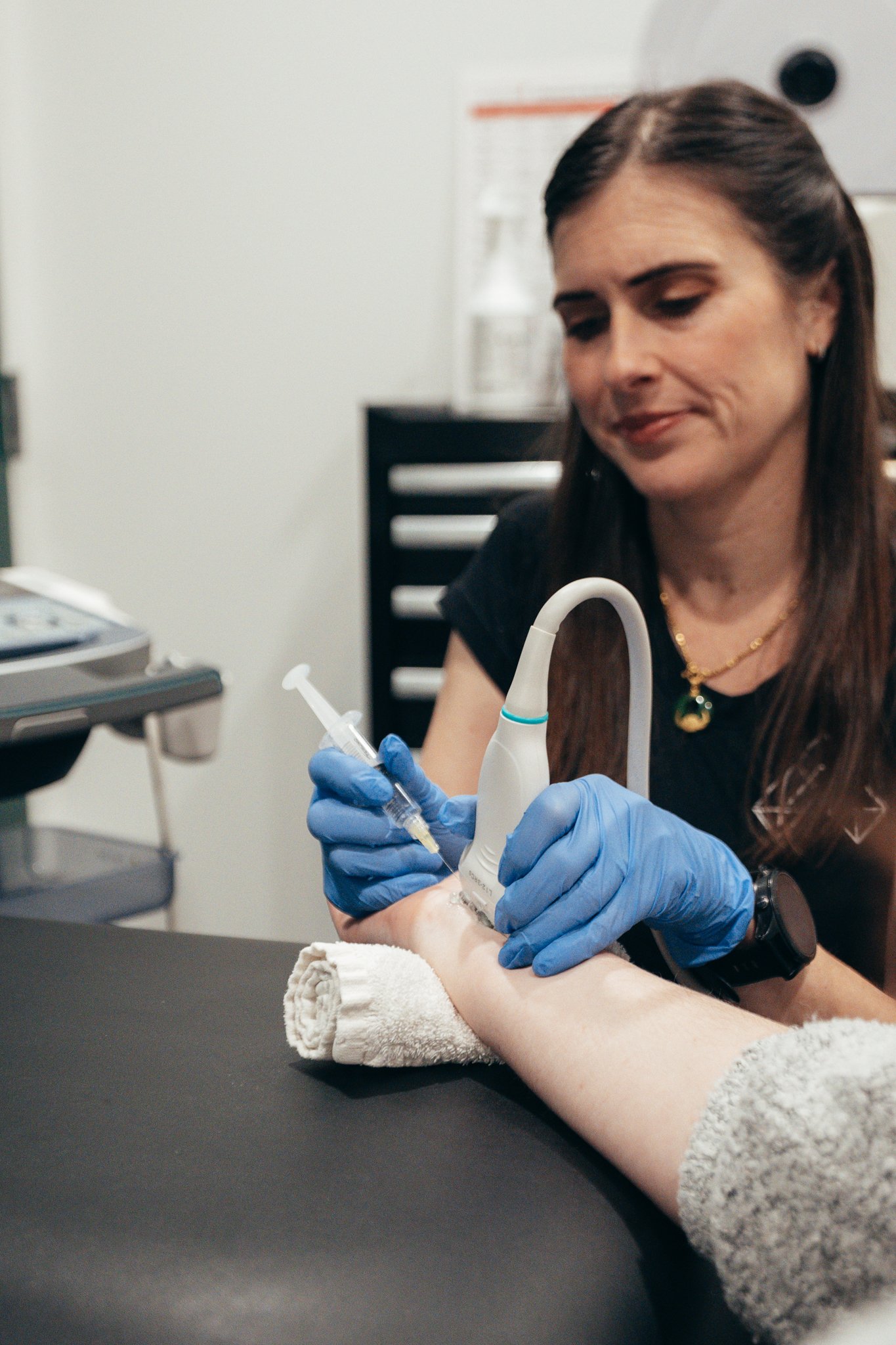
Evaluation: The clinician identifies the specific nerves or nerve branches contributing to the patient’s pain using physical examination, motion testing, and sometimes ultrasound imaging.
Preparation: The skin is sterilized, and a fine 27- or 30-gauge needle is used.
Injection: Tiny volumes of 5% dextrose are placed along the course of the nerve at multiple small points. The sensation is brief and mild.
Post-procedure: No anesthesia or downtime is required. Patients can resume daily activities immediately and often notice lightness, warmth, or reduced stiffness within minutes.
Treatment frequency:
Most protocols call for 4–6 sessions spaced one to four weeks apart. Initial relief may last only hours to days, but the effects build cumulatively for longer-lasting relief at each subsequent appointment.
In my practice, I typically request three sessions, one to two weeks apart, and then start spacing them longer until injections are no longer needed.
Conditions Successfully Treated with PIT
Research and clinical experience have shown PIT’s remarkable range of applications. It is effective for both neuropathic and musculoskeletal conditions, especially when inflammation or nerve sensitization drives symptoms.
Commonly treated conditions include:
Chronic headache and migraines: Irritated sensory nerves in the scalp and neck, such as branches of the trigeminal and greater occipital nerves.
Chronic tendinopathies: Patellar tendinitis, Achilles tendinopathy, iliotibial band syndrome, and lateral epicondylitis (“tennis elbow”) often involve irritated superficial nerves overlaying the tendons.
Peripheral entrapment neuropathies: Carpal tunnel syndrome, tarsal tunnel syndrome, and meralgia paresthetica all respond well to PIT.
Post-surgical or post-traumatic pain: Nerves irritated by scars after surgeries (e.g., total knee replacement, hernia repair, and C-section scars).
Degenerative joint disorders: Especially knee osteoarthritis and shoulder pain following stroke (hemiplegic shoulder pain).
Complex Regional Pain Syndrome (CRPS): PIT can calm overfiring sympathetic nerves contributing to severe allodynia and swelling.
In short, PIT bridges the gap between structural injury repair and chronic pain modulation, bringing balance to an overexcited nervous system.
Evidence and Clinical Outcomes
Though PIT is relatively new compared to other injection therapies, growing research supports its efficacy. In multiple clinical trials and case series, significant improvements have been observed in both pain scores and functional outcomes.
A few notable findings include:
Knee Osteoarthritis: Studies show VAS pain reductions of 70–88%, with corresponding improvements in WOMAC functional scores over 3–6 sessions. Sustained benefits were observed for up to one year post-treatment.
Carpal Tunnel Syndrome: Dextrose injections outperform saline or steroid controls, offering superior pain and nerve conduction improvements.
Achilles Tendinopathy: In Dr. Lyftogt’s original trials, up to 93% of patients reported “good” or “excellent” results after 2–3 sessions.
Long-term relief: Follow-ups at one to three years reveal 88% of patients maintaining significant improvement without recurrence or dependence on pain medications.
While larger randomized controlled trials are still emerging, consistent outcomes across studies and clinical curves highlight PIT’s therapeutic robustness.
What Makes PIT Different from Other Regenerative Therapies
It’s easy to confuse PIT with other injectable approaches like prolotherapy or platelet-rich plasma (PRP) therapy, but the mechanisms and target tissues differ substantially.
In many integrative clinics, PIT is often combined with other modalities — for example, prolotherapy or PRP for deeper tissue repair and PIT for neural modulation — creating a synergistic regenerative pain protocol.
Why Dextrose? The Healing Power of a Simple Sugar
It might sound surprising that a solution of plain glucose can have such profound effects, but the science is compelling. Dextrose is a biologically compatible sugar that cells use for energy. When used therapeutically:
It is non-toxic, safe for subcutaneous use, and metabolized naturally by tissues.
It gently modulates cell signaling to reduce excessive nerve firing without numbing.
Unlike corticosteroids, it does not suppress immune or repair processes.
It provides osmotic balance and can draw out inflammatory mediators from the extracellular space.
In PIT, the goal is not to “burn” or anesthetize a nerve but to restore its integrity by providing a corrective biochemical signal — calming, nourishing, and rehabilitating the affected area.
Safety and Side Effects
One of the most attractive features of PIT is its exceptional safety profile. Because the injections are superficial and use a non-drug, non-steroidal solution, complications are exceedingly rare.
Common, mild side effects include:
Temporary soreness or bruising at the injection site
Mild skin irritation or transient lightheadedness
Temporary stiffness or fatigue due to improved local circulation
Serious reactions such as infection or nerve injury are virtually unheard of in published studies. PIT’s non-invasive nature and absence of systemic effects make it ideal for patients unable to tolerate medications or corticosteroids.
Integrating PIT into Pain Management
PIT fits seamlessly into both conventional and regenerative pain management strategies. It can be used as a standalone treatment or coupled with physical therapy, myofascial release, acupuncture, or corrective exercise programs.
Clinicians appreciate its simplicity and rapid learning curve, while patients value its comfort and speed. Results can often be seen in minutes — a testament to how powerfully peripheral nerves influence pain patterns.
For chronic pain patients frustrated by endless medications or inconclusive imaging, PIT offers not just symptom control but hope for natural recovery.
Comparing Cost and Accessibility
Compared to advanced biologics like PRP or hyaluronic acid, PIT is significantly more affordable. Because it uses readily available medical-grade dextrose, costs are primarily procedural, not material.
Average price per session: Very affordable, usually 1/20th of PRP.
Recovery time: None — patients can usually return to work or exercise immediately.
Clinical setting: Can be performed in outpatient clinics without specialized lab equipment.
This accessibility makes PIT an appealing entry point for patients exploring regenerative options for pain relief.
Looking Ahead: The Future of Neural Regeneration
As understanding of pain evolves, treatments like PIT illustrate a paradigm shift — from suppressing symptoms to restoring physiological harmony.
Emerging research is exploring combinations of PIT with ultrasound guidance, microcurrent therapy, or biologic agents to deepen nerve recovery. Additionally, investigations into TRPV1 receptor biochemistry may lead to improved formulations and longer-lasting protocols.
Regenerative neurology is a frontier field, and PIT may well serve as its foundation — a natural, low-risk, low-cost intervention that redefines how clinicians treat chronic pain.
Key Takeaways
Perineural Injection Therapy (PIT) uses 5% dextrose injections to calm inflamed peripheral nerves, reduce neurogenic inflammation, and restore normal nerve function.
It is effective for chronic tendinopathies, arthritis-related pain, post-surgical neuralgia, and various neuropathic syndromes.
PIT offers rapid, lasting relief with minimal risk — without narcotics, surgery, or steroids for some people.
Clinical studies show significant improvements in pain and mobility across several conditions, with durable results lasting years.
Compared with prolotherapy and PRP, PIT specifically targets nerve dysfunction, making it uniquely suited for neuropathic and mixed pain conditions.
Perineural Injection Therapy stands as a remarkable example of how regenerative medicine continues to evolve — shifting the view of pain from something to be suppressed, to something to be healed. With proper diagnosis, skilled application, and patient commitment, PIT offers a pathway back to movement, comfort, and vitality.
